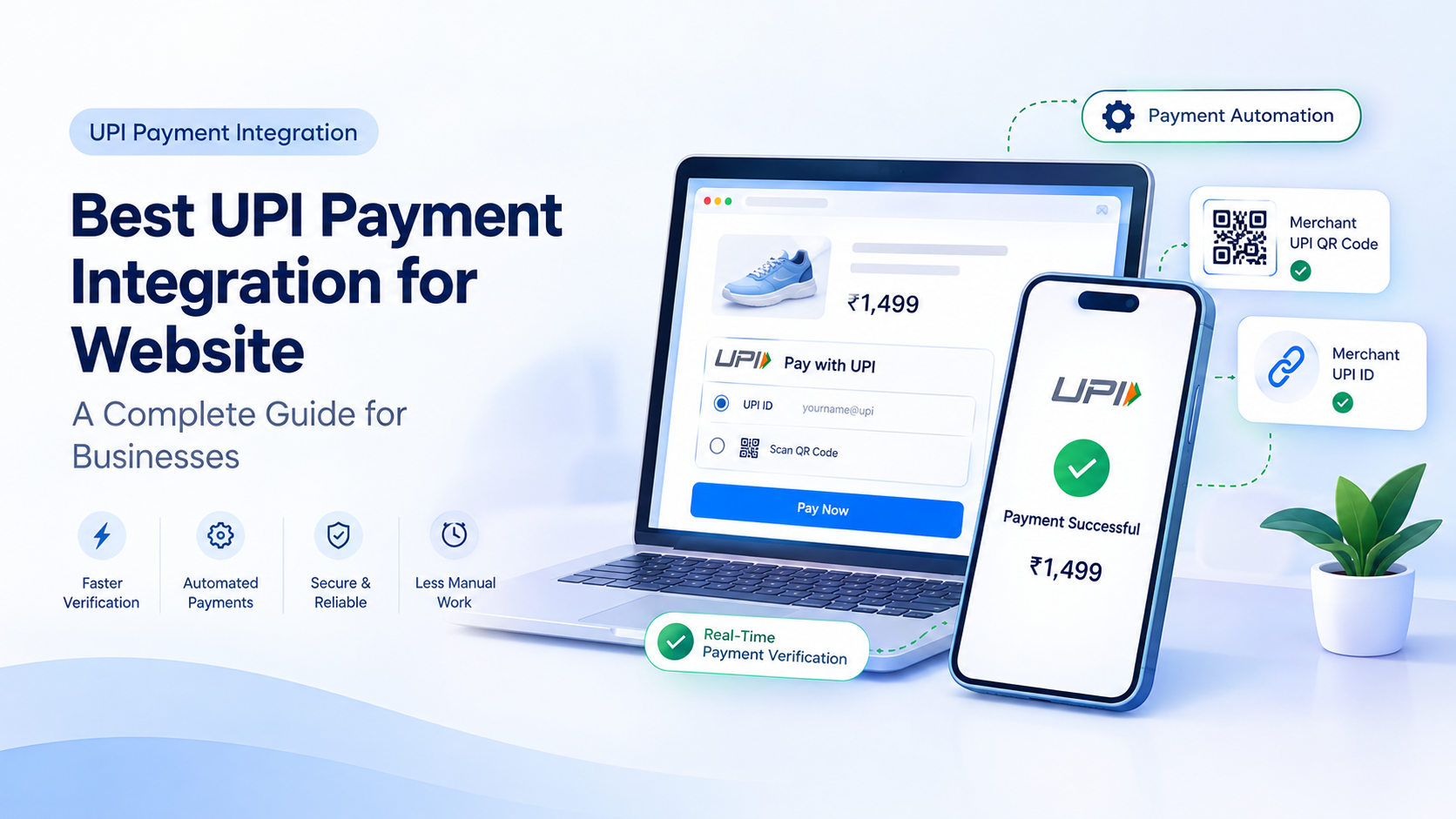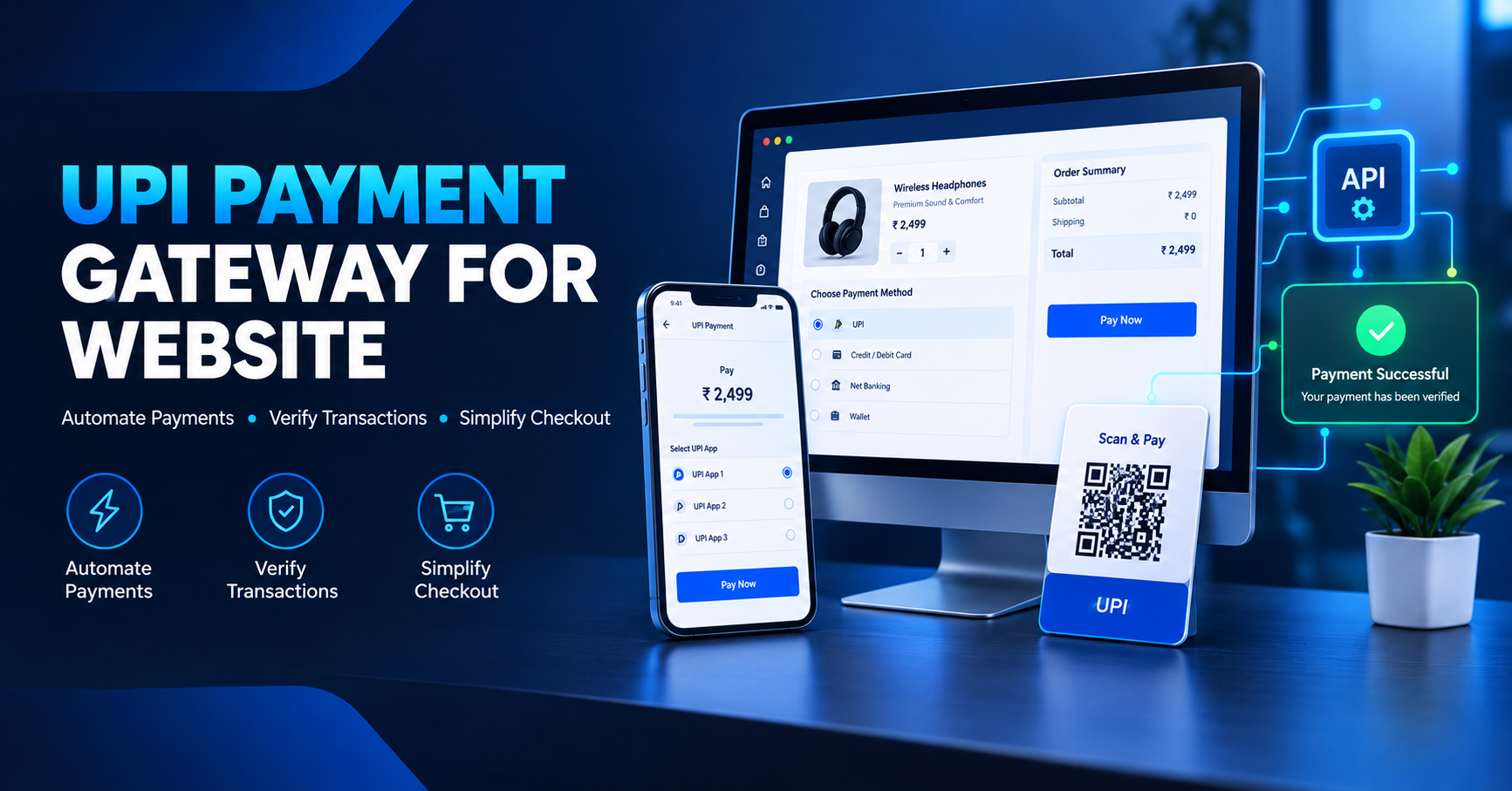
Accept UPI Without a Payment Gateway: A Smarter Way to Collect Online Payments
Online payments have become an important part of running a business in India. Whether you operate an e-commerce website, a mobile application, a subscription platform or an online service, providing customers with an easy payment option can make a big difference to their experience.
UPI is one of the most commonly used digital payment methods in India. Customers are already familiar with scanning QR codes and making payments through apps such as Google Pay, PhonePe and other UPI-supported applications.
However, many businesses face a common problem when they want to accept UPI payments on their websites or applications.
Traditional payment gateway integration can involve additional onboarding, technical integration, account requirements and commercial charges. Some businesses already have a Merchant UPI ID or business QR code and simply want to use their existing payment setup for online collections.
This raises an important question:
Can you accept UPI without a payment gateway?
Yes, businesses can collect UPI payments directly through eligible merchant UPI arrangements, such as Merchant UPI IDs and QR codes, without necessarily integrating a traditional payment gateway.
But collecting a payment and automatically verifying that payment are two different things.
This is where UPI payment automation becomes useful.
With JaduPe, businesses can connect their existing Merchant UPI ID or QR code with smart payment automation technology. It helps automate payment verification, reduce manual work and deliver a smoother payment experience on websites and mobile applications.
Let's understand how this works.
What Does It Mean to Accept UPI Without a Payment Gateway?
Accepting UPI without a payment gateway means collecting payments directly through your existing UPI-enabled merchant setup instead of relying on a traditional third-party payment gateway for every transaction.
For example, suppose you already have a Merchant UPI ID or business QR code from your existing banking or merchant arrangement.
You can use that payment setup to receive money from customers through supported UPI applications.
A customer can scan your QR code or use the available UPI payment option, complete the transaction and send money directly to your linked merchant account.
This approach can be useful for businesses that:
-
Already have an active Merchant UPI ID.
-
Have a business UPI QR code.
-
Want to collect payments through their website.
-
Need UPI payment options inside their mobile application.
-
Want to avoid unnecessary changes to their existing merchant setup.
-
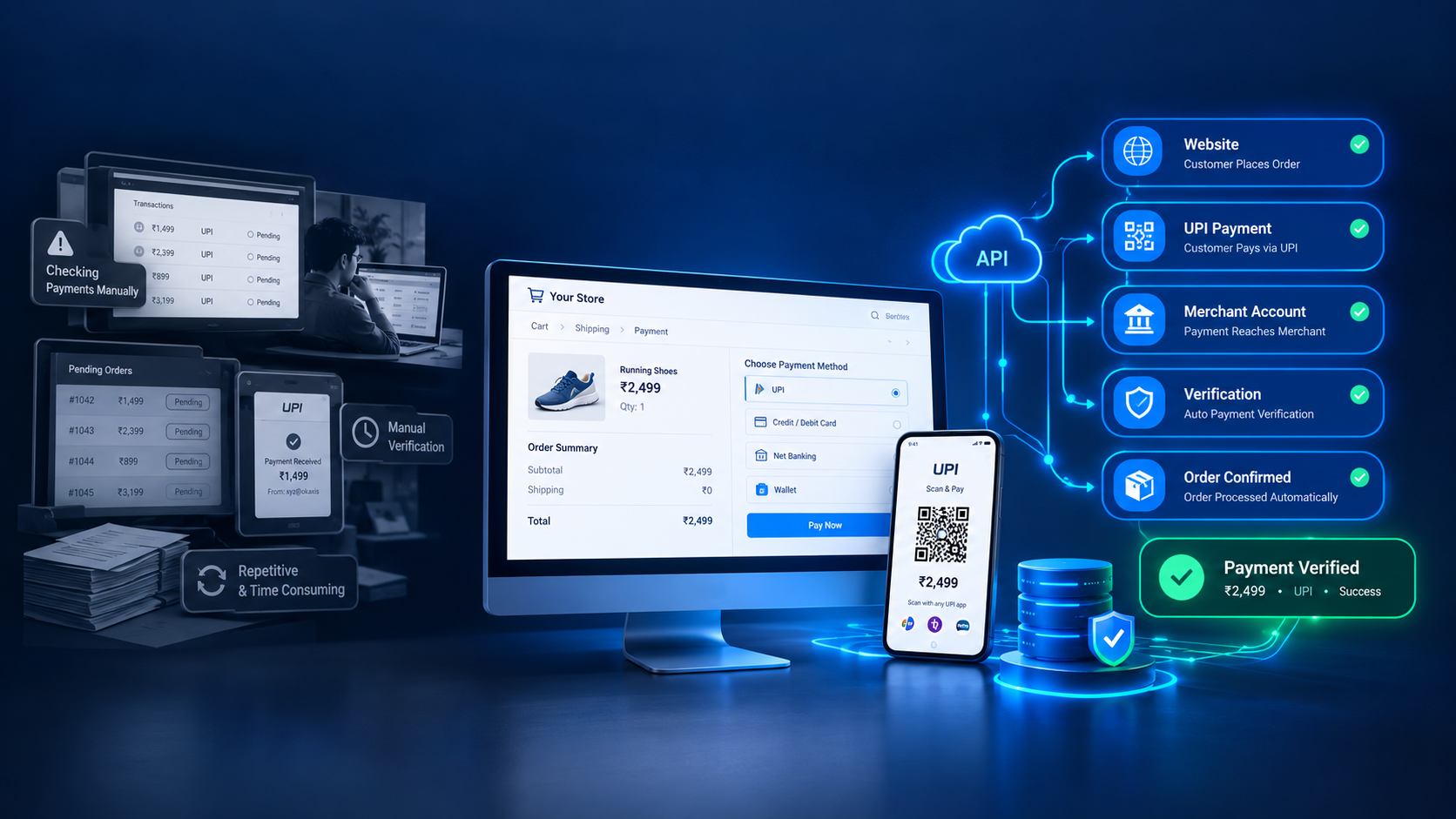
Need automated payment verification instead of checking transactions manually.
The important point is that accepting UPI directly does not automatically provide the features of a payment gateway. Businesses still need a reliable way to manage payment status and connect successful payments with their orders.
Can You Accept UPI Payments Without a Payment Gateway in India?
Yes. Depending on your merchant arrangement and applicable bank or payment provider terms, you can accept UPI payments directly using an eligible Merchant UPI ID or QR code.
For example, a business may already receive payments through its merchant QR code at a physical store.
The same existing merchant payment setup may also be used for supported online collection workflows.
Here is a simple example:
Imagine you operate an online store selling products worth ₹1,500.
Instead of immediately integrating a traditional payment gateway, you can offer customers a supported UPI QR payment option connected to your existing merchant setup.
The customer makes the payment using their preferred UPI application, and the money is received through the linked merchant arrangement.
However, there is one challenge.
How will your website know that the customer has actually completed the payment?
If your website only displays a static QR code, you may need to check the merchant transaction records and manually confirm the payment.
This can become difficult when multiple customers are making payments at the same time.
A payment automation solution can help address this problem.
How to Accept UPI Without a Payment Gateway Using Your Existing Merchant UPI ID?
If you already have a Merchant UPI ID or business QR code, you may not need to completely change your existing payment setup.
You can build a suitable UPI collection workflow around it.

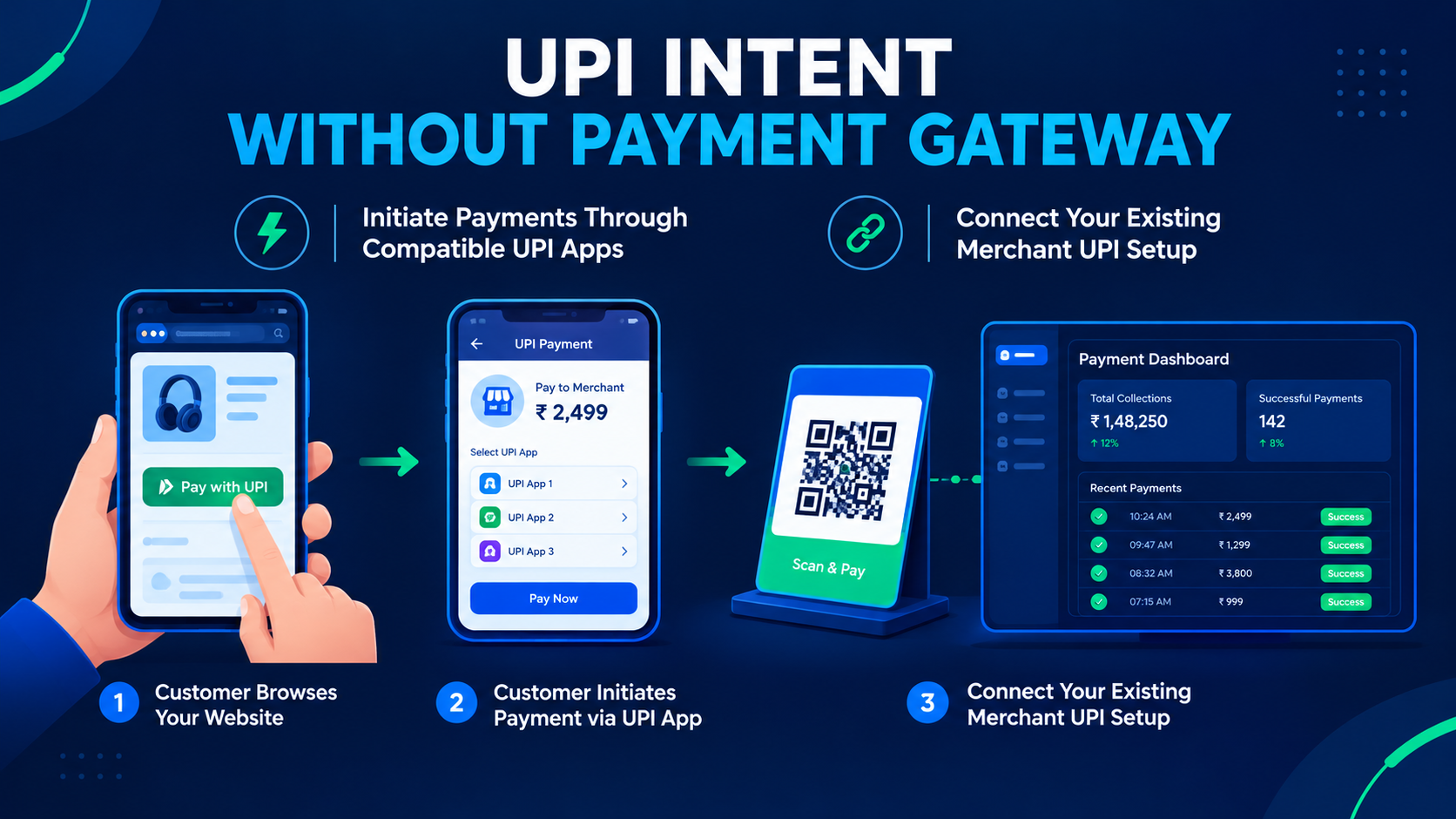
Here is how the process generally works.
Step 1: Get Your Existing Merchant UPI ID or QR Code
First, you need an eligible Merchant UPI ID or business QR code.
This can be obtained through your existing bank or authorized merchant service provider.
Make sure your merchant account is active and supports the type of payment collection you intend to perform.
Step 2: Connect Your Merchant Payment Setup
Use a compatible payment automation solution to connect your existing merchant UPI setup.
The objective is to use your existing payment infrastructure rather than unnecessarily creating an entirely new merchant arrangement.
Step 3: Generate a UPI Payment Request
When a customer places an order on your website or application, the system can generate a suitable UPI payment request or dynamic QR code, depending on the supported integration.
The payment amount and relevant order information can be associated with the payment workflow.
Step 4: Customer Completes the UPI Payment
The customer scans the QR code or opens the supported UPI payment option.
They can complete the transaction using their preferred UPI application.
Step 5: Verify the Payment Status
Once the payment is made, the automation system checks the available payment information to identify the transaction status.
This helps reduce the need for businesses to manually check every transaction.
Step 6: Update the Order Automatically
After successful verification, the website or application can receive the payment status and update the corresponding order.
For example, an order can move from pending payment to payment completed.
This creates a more organized payment experience for both customers and businesses.
Why Do Businesses Want to Accept UPI Without a Payment Gateway?
Many businesses already have access to merchant payment facilities. They do not always want to replace their existing setup just to start collecting online payments.
There are several reasons why businesses explore direct UPI collection solutions.
1. Use Your Existing Merchant UPI ID
If your business already has a Merchant UPI ID, you may want to continue using it instead of moving to an entirely different payment arrangement.
A suitable integration can help connect your existing payment setup with your website or application.
2. Reduce Dependence on Traditional Gateway Integration
Some businesses only need a UPI-focused payment collection workflow.
They may not require every feature offered by a traditional payment gateway.
Using an eligible merchant UPI setup with payment automation can be an alternative for these specific requirements.
3. Reduce Manual Payment Verification
One of the biggest challenges of direct UPI collection is confirming every transaction.
When customers make payments throughout the day, manually checking each transaction can consume valuable time.
Payment automation helps businesses identify successful payments and update their order records through an integrated workflow.
4. Support Website and Mobile App Payments
Businesses can integrate UPI payment options into supported websites and mobile applications.
This makes it easier for customers to complete payments without depending entirely on manual payment instructions.
5. Improve Customer Payment Experience
A structured payment process helps customers understand how to make payments and what happens after a successful transaction.
Clear payment status updates can also reduce confusion and unnecessary customer support requests.
What Is UPI Payment Automation?
UPI payment automation is a technology-based approach that helps businesses manage payment collection and verification with less manual involvement.
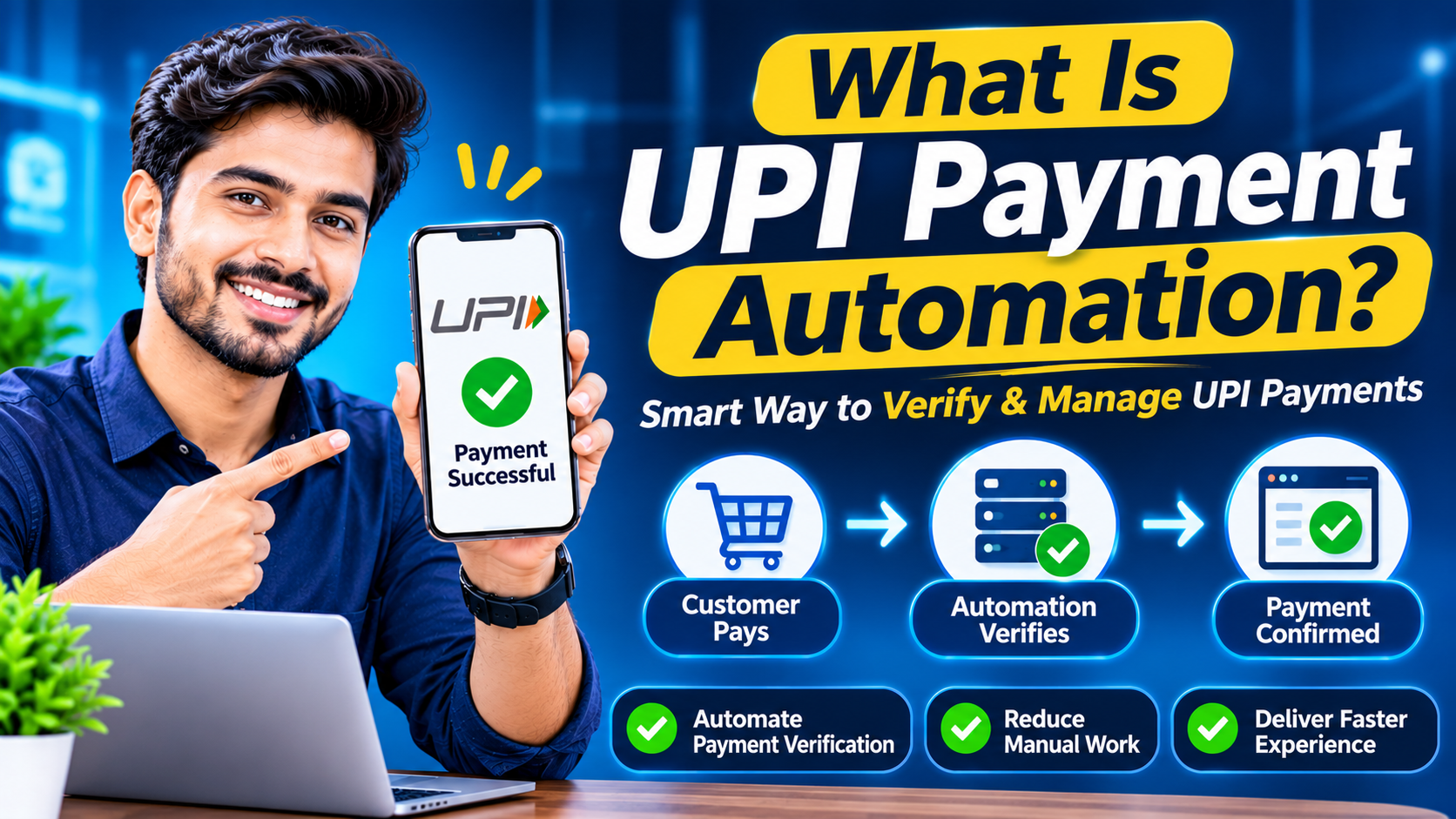
Traditional direct UPI collection may involve displaying a QR code and asking customers to complete the payment.
After that, someone may need to check the merchant account and confirm whether the money has been received.
UPI payment automation connects the payment workflow with the business website or application.
Depending on the supported merchant integration, the process can include:
-
Generating dynamic UPI QR codes.
-
Creating payment requests for customer orders.
-
Checking available transaction information.
-
Verifying payment status.
-
Sending payment status notifications.
-
Updating order records.
-
Connecting payment events with business software through webhooks.
The objective is simple: reduce repetitive manual work and make payment management easier.
For businesses receiving multiple UPI payments every day, automation can make a meaningful difference.
Static UPI QR vs Dynamic UPI QR: What Is the Difference?
Businesses often use QR codes to collect UPI payments. However, static and dynamic QR codes serve different purposes.
Static UPI QR Code
A static QR code generally contains fixed merchant payment details.
Customers can scan it and enter the amount they want to pay.
This is commonly used by physical stores, small businesses and merchants accepting payments directly.
However, when used for multiple online orders, it can become difficult to identify which payment belongs to which order without an additional verification process.
Dynamic UPI QR Code
A dynamic UPI QR code is generated for a particular payment request.
It can include transaction-specific information such as the payment amount and reference details, depending on the integration.
This makes it useful for websites and applications where different customers place orders with different payment amounts.
Comparison Between Static and Dynamic UPI QR
| Feature | Static QR | Dynamic QR |
|---|---|---|
| QR generation | Fixed | Generated per payment request |
| Payment amount | Customer may enter amount | Can include a predefined amount |
| Order association | Requires additional tracking | Can support order-specific references |
| Website integration | Possible with additional workflow | Suitable for automated workflows |
| Payment verification | Separate verification process | Can be connected to supported verification systems |
For businesses handling multiple online orders, dynamic QR generation combined with payment verification can help organize the payment process.
How JaduPe Helps Businesses Accept UPI Without a Payment Gateway
JaduPe is built around a simple idea: businesses should be able to use their existing Merchant UPI ID or QR code with smart payment automation technology.
Instead of presenting another merchant account or traditional payment gateway arrangement, JaduPe focuses on connecting the merchant's existing payment setup with an automated collection and verification workflow.
This allows businesses to explore a more flexible way of managing UPI payments on their websites and applications.
Connect Your Existing Merchant UPI ID
Businesses can connect their existing eligible Merchant UPI ID or QR code with the supported JaduPe integration.
There is no need to position the solution as a replacement for your existing merchant identity.
Dynamic QR Generation
Generate payment-specific QR codes for supported payment workflows.
This can help businesses associate customer payment requests with their respective orders.
Automated Payment Verification
Reduce the need to manually check every payment.
JaduPe helps automate payment verification through its supported integration technology.
Payment Status Webhooks
Connect payment status events with your website or application through webhooks.
This helps your software respond to relevant payment updates.
Instant Payment Notifications
Keep your business system informed about payment events through supported notification workflows.
Easy API Integration
Developers can connect payment automation functionality with existing websites, applications and business software using API integration.
Website and Mobile App Support
JaduPe supports payment automation use cases for businesses operating websites and mobile applications.
The focus is to make existing merchant UPI infrastructure more useful for online payment collection.
Who Can Benefit From Accepting UPI Without a Payment Gateway?
This approach may be useful for different types of online businesses.
E-Commerce Websites
Online stores can use supported UPI payment workflows to collect customer payments and associate them with individual orders.
Mobile Application Owners
Businesses operating Android or other supported mobile applications can explore integrating UPI payment options into their applications.
Subscription-Based Businesses
Platforms that collect recurring or periodic customer payments can explore suitable UPI collection workflows, subject to supported payment arrangements and applicable rules.
Service-Based Businesses
Companies selling digital services, consulting, subscriptions or online solutions can use merchant UPI arrangements to collect payments from customers.
Software and SaaS Businesses
Software companies can integrate payment collection into their existing platforms and automate relevant payment status updates.
Small and Medium Businesses
Businesses that already have a merchant UPI setup can explore ways to connect their existing payment infrastructure with online platforms.
Is Accepting UPI Without a Payment Gateway Safe?
Security should always be considered when selecting any online payment collection method.
Using an existing merchant UPI ID or QR code does not mean that businesses should ignore payment verification or transaction security.
A reliable payment workflow should consider the following:
-
Use an eligible business merchant account.
-
Protect merchant credentials and sensitive integration information.
-
Verify payments using reliable and supported transaction data.
-
Never consider a customer-provided screenshot as proof of payment.
-
Match payments with the correct order or transaction reference.
-
Handle pending, failed and successful payment states properly.
-
Use secure API communication.
-
Follow applicable bank, NPCI and regulatory requirements.
One important point: a UPI payment screenshot or customer confirmation message is not sufficient proof that money has actually been received.
Your system should rely on appropriate merchant-side transaction information and supported verification mechanisms.
Businesses should also understand that direct UPI collection and payment gateway services have different features, responsibilities and operational requirements.
UPI Payment Automation vs Traditional Payment Gateway
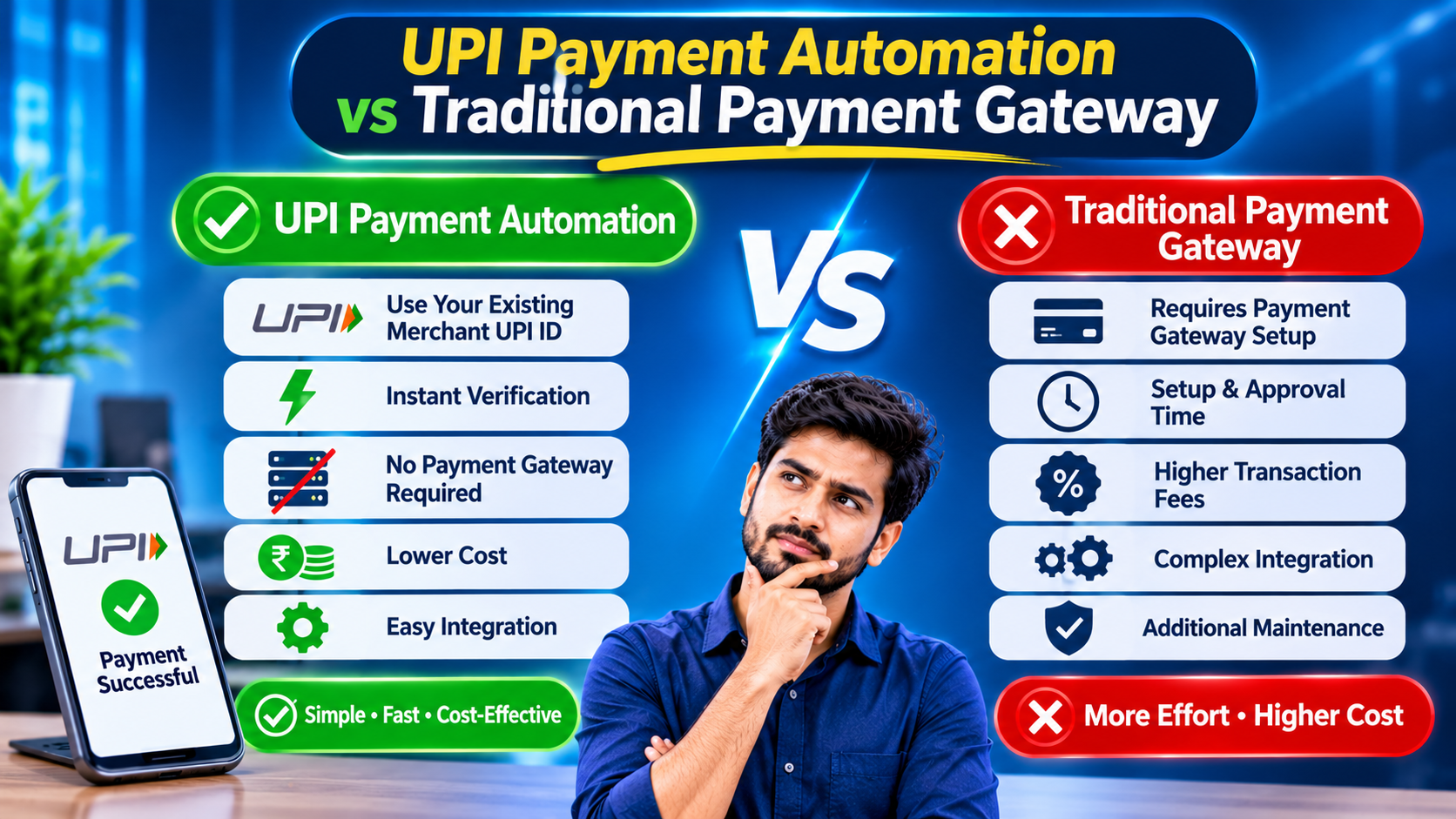
Both approaches can help businesses collect online payments, but they are not exactly the same.
A traditional payment gateway generally provides a broader payment processing infrastructure, which may include multiple payment methods, transaction management and other services.
A UPI payment automation solution focuses on connecting an eligible existing merchant UPI setup with payment collection and verification workflows.
| Feature | Traditional Payment Gateway | JaduPe Payment Automation |
|---|---|---|
| Payment approach | Gateway-based processing | Existing merchant UPI setup |
| Merchant UPI connection | Depends on provider | Core use case |
| QR payment workflow | Provider-dependent | Supported QR automation |
| Dynamic QR generation | Provider-dependent | Available feature |
| Payment verification | Gateway transaction status | Automated merchant payment verification |
| Webhooks | Provider-dependent | Payment status webhooks |
| API integration | Usually available | Available |
| Existing merchant setup | Depends on provider | Designed around existing Merchant UPI |
The right approach depends on your business model, merchant eligibility, required payment methods and technical requirements.
If your primary requirement is UPI collection using an existing merchant setup, JaduPe provides a focused payment automation approach.
Frequently Asked Questions
1. Can I accept UPI without a payment gateway?
Yes. Businesses can accept UPI payments directly through eligible merchant UPI arrangements, including Merchant UPI IDs and QR codes. However, automated online payment verification requires a suitable supported integration.
2. How can I accept UPI payments on my website without a payment gateway?
You can use an eligible Merchant UPI ID or QR code with a compatible payment collection workflow. For online orders, you should also implement a reliable payment verification mechanism to confirm successful transactions.
3. Can I use my existing Merchant UPI ID for online payments?
Yes, subject to your merchant provider's terms and supported integration. A compatible solution can help connect your existing Merchant UPI setup with your website or application.
4. What is the difference between UPI QR and UPI payment automation?
A UPI QR code helps customers initiate payments. UPI payment automation goes further by connecting payment requests, transaction verification and payment status updates with your business software.
5. Can I generate dynamic UPI QR codes for my website?
Yes. Dynamic UPI QR codes can be generated for supported payment requests. They can include transaction-specific information to help associate payments with individual orders.
6. How can I automatically verify UPI payments?
Automated UPI verification requires access to suitable merchant-side transaction information through a supported integration. The system can then match the transaction with the relevant payment request and update the order status.
7. Does JaduPe provide a traditional payment gateway?
JaduPe focuses on merchant UPI payment automation rather than operating as a traditional payment gateway. It helps businesses connect their existing Merchant UPI ID or QR code with payment automation technology.
8. Can I integrate JaduPe with my website or mobile application?
Yes. JaduPe provides API integration and payment automation capabilities for supported website and mobile application workflows.
9. Do I need a new merchant account to use JaduPe?
JaduPe is designed around connecting an existing eligible Merchant UPI ID or QR code. The merchant must maintain an active and eligible merchant arrangement with its existing provider.
10. Can JaduPe help reduce manual payment verification?
Yes. JaduPe helps automate payment verification through supported integrations, reducing the need to manually check every customer payment.
Final Thoughts: Accept UPI Without a Payment Gateway Using Smart Automation
Accepting UPI payments without integrating a traditional payment gateway can be a practical option for businesses that already have an eligible Merchant UPI ID or QR code.
However, collecting payments is only one part of the process. Businesses operating websites and applications also need a reliable way to verify payments, update orders and manage payment notifications.
This is where payment automation becomes important.
JaduPe helps businesses connect their existing Merchant UPI ID or QR code with smart payment automation technology.
Automate payment verification, reduce manual work and deliver a faster payment experience on your website or application.
You can continue using your existing merchant payment setup while exploring a smarter way to manage online UPI collections.
Ready to automate your UPI payments?
Explore JaduPe and discover how your existing Merchant UPI ID or QR code can work with smart payment automation.
Website: https://jadupe.com/