Why Online Businesses Are Moving From Manual Payment Checking to Smart Payment Automation
The Growing Need for Smarter Payment Operations
Running an online business today is very different from running one a few years ago. Customers expect to discover a product, place an order, make a payment, and receive confirmation without unnecessary waiting. UPI has played a major role in creating this expectation because digital payments can happen quickly from a smartphone. According to NPCI's latest published statistics, UPI processed 24,508.96 million transactions in August 2026, equivalent to more than 24.5 billion transactions in a single month, with transaction value of about ₹29.82 lakh crore. The scale of this ecosystem makes one thing clear: digital payment is no longer a secondary feature for many Indian businesses; it is part of the everyday customer journey.
But accepting a payment and managing a payment are two different things. A customer may complete a UPI transaction in seconds, while the business may still have to spend several minutes checking whether the payment arrived, matching it with an order, looking at a screenshot, or confirming the transaction manually. That gap creates unnecessary operational friction. As order volumes increase, the problem becomes even more obvious because a workflow that seems manageable at 10 payments per day can become extremely difficult at 100, 500, or thousands of payments. This is why businesses are increasingly looking at smart payment automation as a way to connect payment activity with their websites, applications, order systems, and internal operations.
UPI Has Changed Customer Payment Expectations
Customers have become accustomed to fast digital interactions. They do not necessarily think about what happens behind the scenes after they tap the payment button; they simply expect the order to move forward once their payment succeeds. NPCI itself describes UPI as supporting merchant payments as well as person-to-person transactions, while QR-based payments are an established part of the UPI experience.
For an online business, that means the payment experience cannot stop at displaying a UPI ID or QR code. The business also needs a reliable way to understand the payment status and connect it with the correct customer transaction. This is where automation becomes valuable. Instead of making employees repeatedly perform the same checking process, businesses can introduce technology that helps connect the merchant UPI account, payment verification, website or app, and order status into one more organized workflow.
What Manual Payment Checking Looks Like
Manual payment verification often starts innocently. A small business may display its Merchant UPI ID or QR code at checkout and ask customers to complete the payment. After payment, the customer may send a screenshot or transaction reference. Someone from the business then checks the merchant application, bank notification, transaction history, or another payment record before approving the order. When only a handful of transactions are involved, this process may seem perfectly reasonable. The problem begins when the business grows and the same process has to be repeated dozens or hundreds of times every day.
Imagine an online store receiving 300 orders in a day. If every payment requires a team member to manually identify the transaction, compare information, confirm the amount, and update the order, a significant amount of employee time disappears into repetitive administrative work. There is also the possibility of delays when the person responsible for checking payments is busy, unavailable, or handling multiple transactions simultaneously. Customers do not see that internal workload; they simply see that their order is still waiting for confirmation. That is exactly where manual payment checking can become a bottleneck for an otherwise efficient online business.
Why Screenshot-Based Verification Becomes a Problem
Payment screenshots can be useful as supporting information, but they should not become the foundation of an entire payment operation. A screenshot is essentially an image supplied by the customer; it does not automatically provide a reliable, system-level connection between a payment event and an order in the merchant's database. Someone still has to inspect the information and determine what it means. As order volume increases, this creates more opportunities for duplicate submissions, incorrect matching, delayed confirmation, and human mistakes.
The better approach is to build a workflow where the business application can work with relevant payment-status information rather than relying entirely on customers to prove that they have paid. That does not mean ignoring security or compliance requirements. It means using technology to reduce unnecessary repetitive work while keeping appropriate verification controls in place. JaduPe, for example, positions its technology around connecting an existing supported Merchant UPI ID or QR Code with payment automation so businesses can reduce manual screenshot checking and create a more streamlined payment workflow.
The Hidden Cost of Manual Payment Verification
The biggest problem with manual verification is not always the visible salary cost of the employee performing the task. The real cost can appear across several parts of the business. A support employee who spends hours checking payments is not spending that time answering customer questions, improving service, handling operations, or helping the company grow. Developers may also be asked to build workarounds around a manual process instead of creating better customer-facing features. At the same time, customers can experience delays even though their payment itself was completed quickly.
There is also an operational cost associated with uncertainty. When an order says "payment pending," somebody has to determine whether the customer actually paid, whether the payment was received, whether it belongs to that order, and what should happen next. If the business processes hundreds of transactions, these small uncertainties can accumulate into a large operational burden. Smart payment automation aims to reduce this friction by creating a technology-assisted connection between payment events and business workflows. Instead of asking people to repeatedly perform the same basic checks, the system can handle suitable parts of the process automatically while leaving exceptions and important decisions for human review.
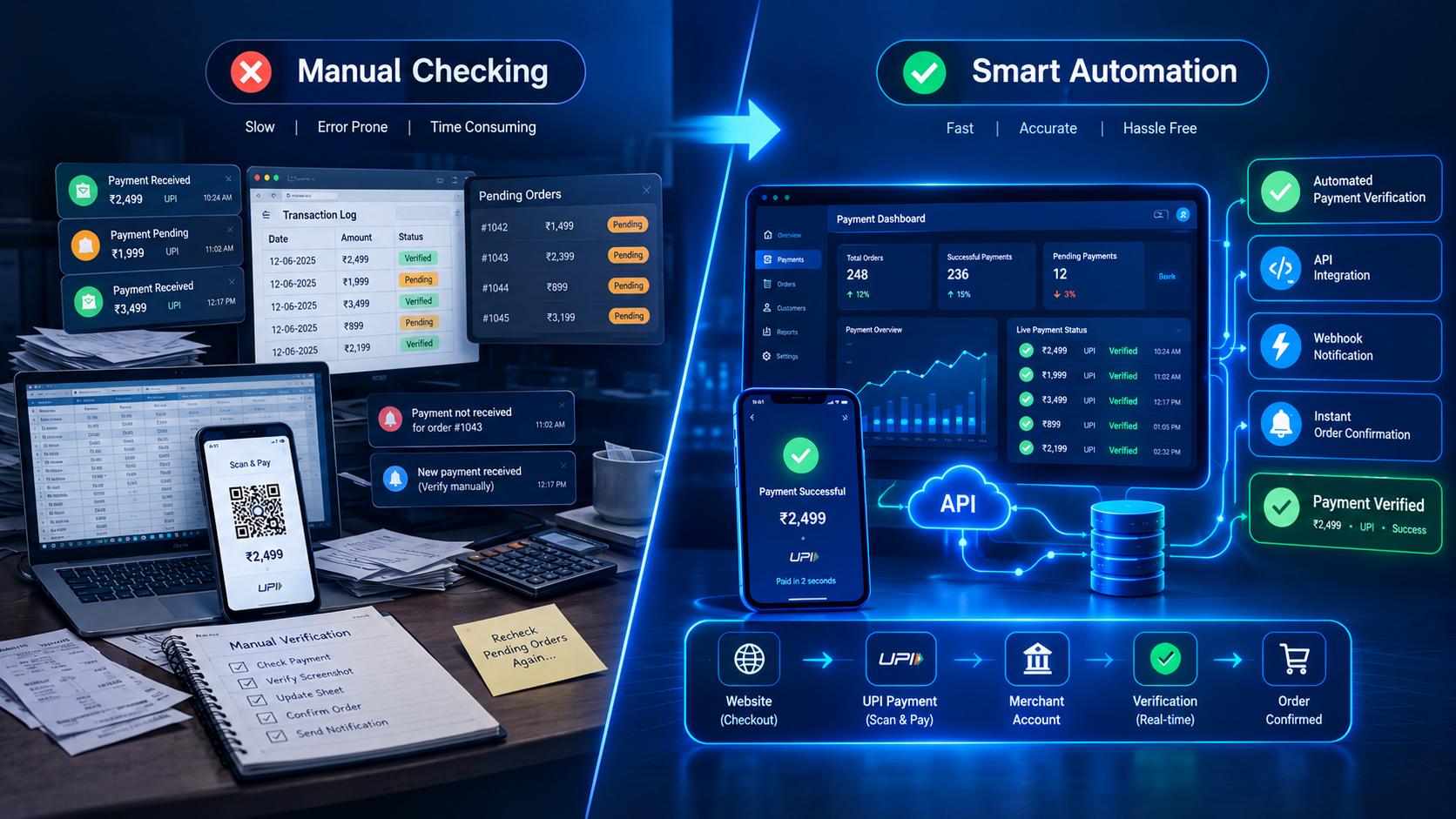
What Is Smart Payment Automation?
Smart payment automation is the use of technology to automate appropriate parts of the payment lifecycle, particularly payment-status handling, verification workflows, notifications, order updates, and integration between payment infrastructure and business software. The concept is broader than simply generating a QR code. A QR code allows a customer to initiate a payment, but an online business also needs to know what happened after the customer made that payment. Automation provides the technology layer that helps connect those events with the business's website, mobile application, backend, or order-management system.
A simplified workflow looks like this:
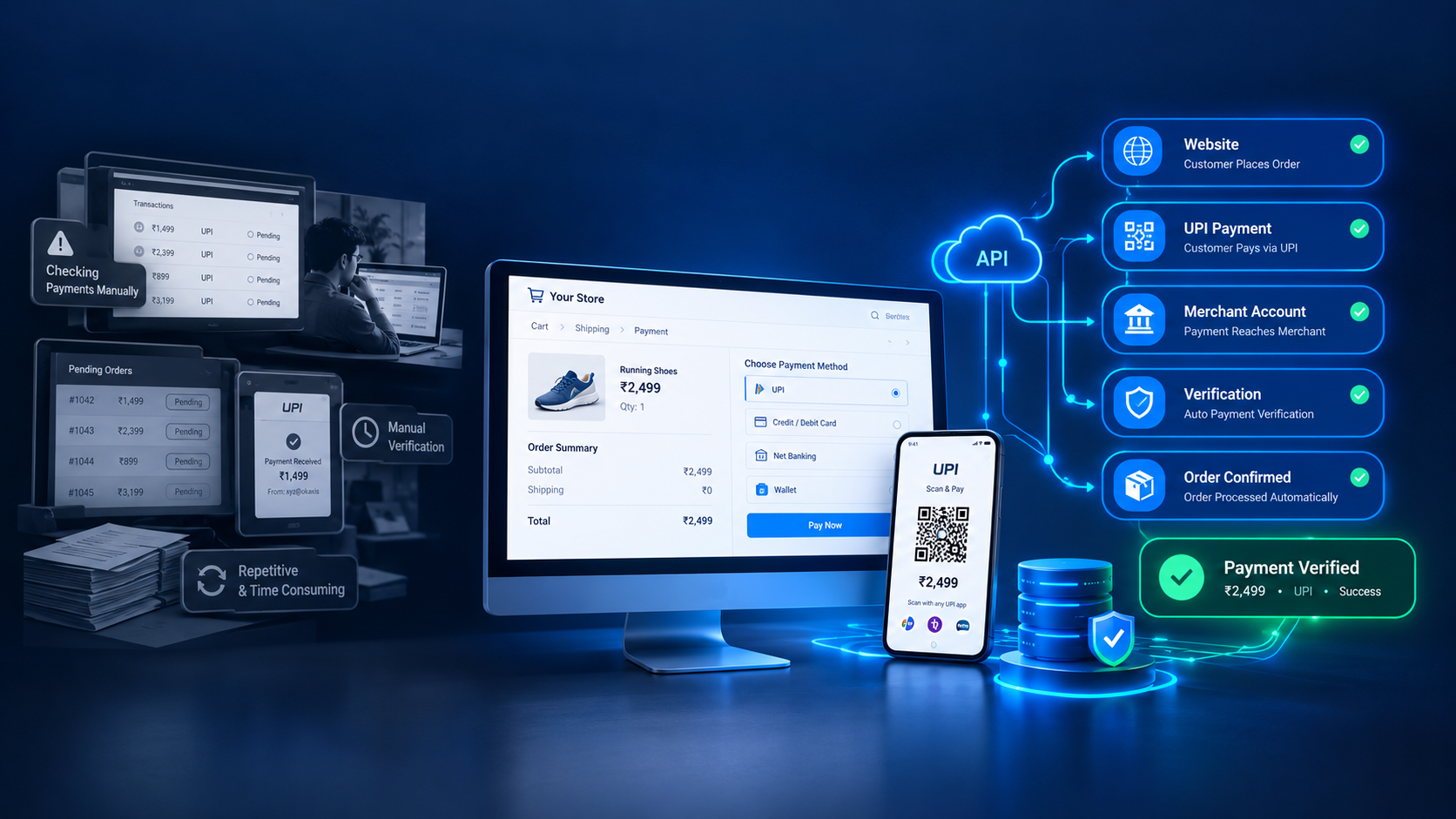
Customer → Website/App → UPI Payment → Merchant Account → Payment Verification → Status Update → Order Processing
The exact implementation depends on the merchant setup, technology provider, integrations, and applicable requirements. But the objective remains straightforward: reduce unnecessary manual intervention and make payment-related operations more connected. JaduPe describes this approach as Smart Merchant Infrastructure, helping businesses connect their existing Merchant UPI ID or QR Code with payment automation technology rather than forcing them to rethink their entire payment collection setup.
From Payment Collection to Payment Confirmation
There is an important difference between collecting money and confirming a business transaction. A customer can scan a QR code and make a UPI payment, but the website still needs to know whether that particular order has been successfully paid. If the payment confirmation process remains manual, the business has automated only the first half of the journey.
Smart payment infrastructure focuses on connecting the two sides. The payment happens through the supported merchant setup, while technology helps process relevant payment information and communicate the resulting status to the connected business application. This can help move an order from "Payment Pending" to "Payment Successful" without requiring an employee to manually inspect every transaction. The goal is not to make the payment process complicated; it is to make the workflow behind the payment more intelligent.
How Automated UPI Payment Verification Works
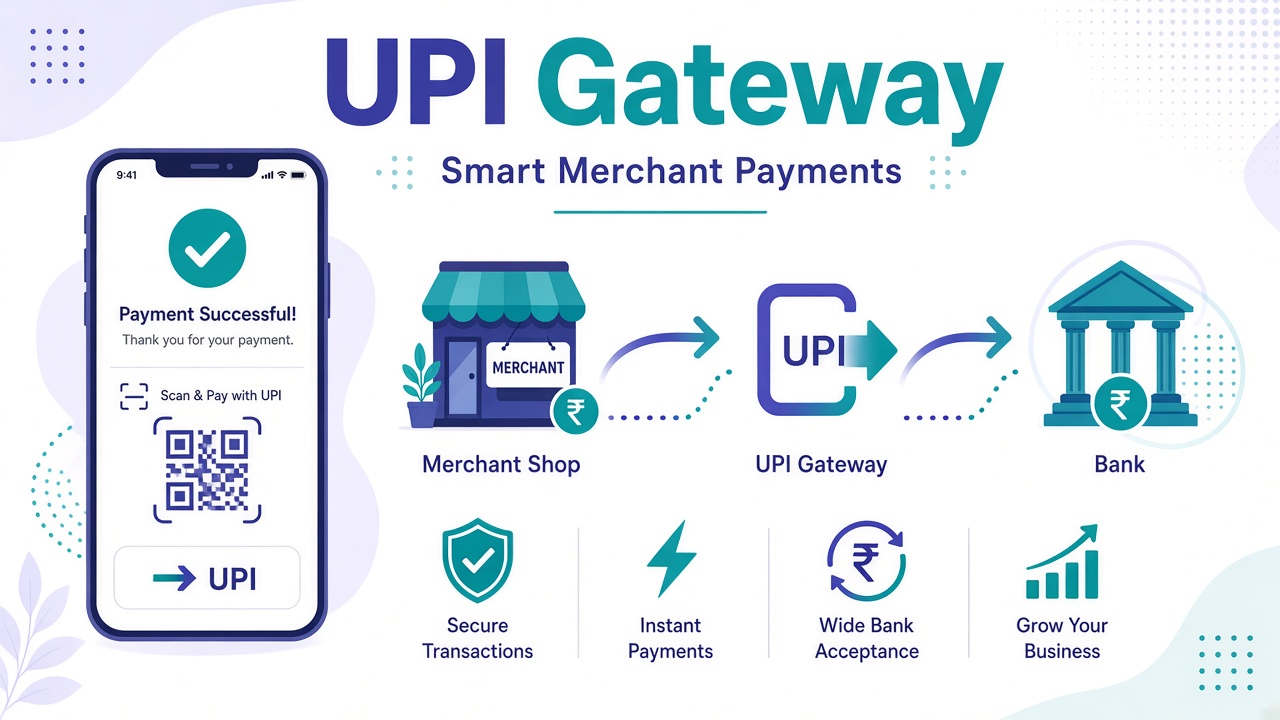
At a high level, automated UPI payment verification connects a business's merchant payment setup with a software workflow. A customer starts an order on the website or mobile application and selects UPI. Depending on the implementation, the customer may use UPI Intent, a QR code, or another supported UPI payment experience. Once the payment is made, the connected payment infrastructure processes the relevant payment information and determines the applicable status. The business application can then use that status to update the order or trigger the next step.
Consider an online store selling a product for ₹1,499. The customer places the order, selects UPI, completes the payment, and the payment is associated with the relevant transaction workflow. Once the payment is successfully verified, the application can update the order status and allow fulfillment to continue. JaduPe's own product material describes this type of workflow around existing Merchant UPI accounts, payment verification, APIs, webhooks, UPI Intent, and QR-based payment collection.
Connecting Merchant UPI With a Website or App
For businesses, the real value appears when payment technology connects with the software they already use. An e-commerce website may need to update an order. A food delivery application may need to confirm an order before sending it to the restaurant. A SaaS platform may need to activate a subscription after successful payment. A donation platform may need to record a contribution and show confirmation to the donor.
In each example, the payment itself is only one event in a larger workflow. The technology needs to help the business application understand that event. APIs can provide a structured way for systems to communicate, while webhooks can be used to send relevant payment events to a connected application when supported. JaduPe provides developer-focused APIs and webhook capabilities as part of its smart merchant infrastructure offering.
Why Businesses Are Moving Beyond Manual Workflows
The shift toward automation is not simply about replacing people with software. It is about allowing people to spend their time on work that actually requires human judgment. If a team member spends several hours every day checking whether a payment was received, that is a repetitive operational task that technology may be able to reduce. When the same business starts processing substantially more orders, automation becomes less of a luxury and more of an operational requirement.
A manual workflow also becomes difficult to standardize. Different employees may check transactions differently. One person may confirm quickly, another may investigate every detail, and a third may miss an important transaction when the workload becomes heavy. A properly designed automated workflow can provide more consistent handling of normal payment events while routing unusual cases for human attention. That creates a healthier balance between automation and human oversight.
Faster Order Confirmation and Customer Experience
Customers generally do not want to wait for an internal payment team to confirm something they believe they have already completed. If a payment is successful but an order remains pending for several minutes, the customer may wonder whether the transaction failed. That uncertainty often leads to additional support messages such as "Did you receive my payment?" or "Why is my order still pending?"
A connected payment workflow can reduce this friction by communicating payment status to the website or application more efficiently. The result can be a clearer customer journey: payment completed, status updated, order confirmed, next step shown. JaduPe specifically positions payment automation around creating a faster payment experience and reducing manual verification for websites and mobile applications.
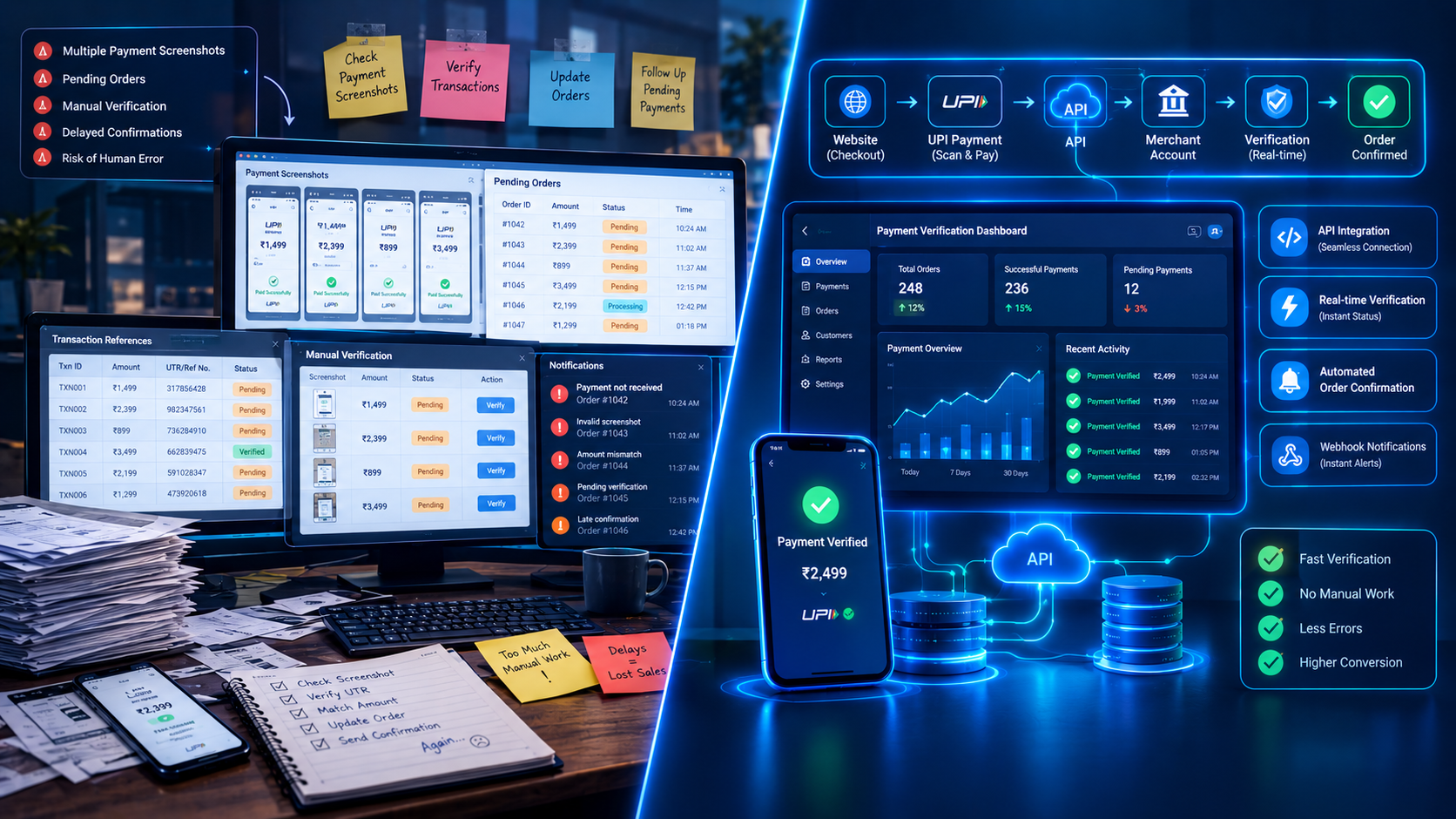
Reducing Human Errors in Payment Operations
Humans are excellent at judgment, problem-solving, communication, and handling exceptions. They are not necessarily ideal for repeating the same transaction-checking task hundreds of times. Repetitive work can lead to missed details, incorrect order matching, delayed updates, or accidental duplication. When money and order status are involved, even a small operational mistake can create a customer-support problem.
Automation can reduce the number of routine decisions employees need to make. A normal successfully verified payment can follow an established workflow, while an unusual transaction can be flagged for manual review. This is a more practical approach than expecting employees to manually inspect every transaction regardless of whether anything unusual happened. The objective should be automation where appropriate, human review where necessary.
APIs and Webhooks in Payment Automation
For developers, payment automation becomes much more useful when it can communicate with the existing software stack. An API can provide a structured interface between the merchant-payment technology and the business backend. Instead of manually entering payment information into an admin panel, a website can interact with connected services programmatically. This makes payment functionality part of the application's architecture rather than an isolated manual process.
Webhooks solve a slightly different problem. Rather than repeatedly asking a system whether something has changed, a webhook can allow the connected application to receive an event when a relevant status change occurs. For example, a successful payment event can trigger a notification to the business backend, which can then update the corresponding order. JaduPe's developer-facing material highlights APIs and webhooks as mechanisms for connecting payment workflows with websites and applications.
Why Developers Need a Reliable Payment Workflow
Developers do not want to build a payment system around screenshots, manual confirmation messages, or spreadsheets. Those approaches may work temporarily, but they become increasingly difficult to maintain as transaction volume grows. A developer-friendly payment infrastructure should provide clear integration points, understandable documentation, predictable status handling, and a practical way to connect payment events with business logic.
For example, a developer may want the following flow:
Create Order → Generate Payment Experience → Customer Pays → Receive Status → Verify → Update Order → Notify Customer
The exact APIs, status values, authentication mechanisms, and error-handling requirements will vary by implementation. But having a defined software workflow gives the development team a foundation on which to build reliable payment-related features.
Existing Merchant UPI ID and QR Code Integration
One of the biggest reasons businesses consider smart merchant infrastructure is that they may already have an established Merchant UPI setup. They may have a business UPI ID, merchant QR code, existing bank relationship, and customers who already know how to pay them. Replacing everything simply because the business wants automation may create unnecessary complexity.
JaduPe's model is built around connecting a supported existing Merchant UPI ID or QR Code with its payment automation technology. Its website states that payments are collected directly in the merchant's own account and that JaduPe does not hold or process customer funds. Businesses should still evaluate their own merchant arrangements, applicable requirements, and compatibility before implementing any payment workflow.
This approach can be attractive because the business can focus on improving the technology layer around an existing payment setup. Instead of thinking, "I need to replace everything," the question becomes, "How can I make my existing merchant payment workflow smarter?"
Smart Merchant Infrastructure vs Manual Verification
| Factor | Manual Payment Checking | Smart Payment Automation |
|---|---|---|
| Payment verification | Human-driven | Technology-assisted |
| Screenshot checking | Often required | Can be reduced significantly |
| Order updates | Manual | Can be automated |
| Scalability | Becomes difficult with volume | Designed to support higher transaction workloads |
| Customer confirmation | Can be delayed | Can be faster |
| Developer integration | Limited/manual workflows | APIs and webhooks can connect systems |
| Transaction handling | Repetitive | Workflow-based |
| Staff workload | Higher | Lower for routine verification |
| Website/App integration | Often disconnected | Can be connected to payment status |
| Exception handling | Human-led | Normal cases automated, exceptions reviewed |
The important point is that automation does not mean every payment situation should be handled without human involvement. Good payment infrastructure should make routine transactions easier while giving businesses appropriate visibility and controls for unusual situations.
Which Online Businesses Can Benefit?
Smart payment automation can be useful across many online business models. E-commerce stores may want successful payments to automatically move orders toward fulfillment. Food delivery applications can connect payment confirmation with order processing. SaaS platforms can use payment events as part of subscription or account-management workflows. Donation platforms can benefit from reducing manual confirmation work when processing many contributions.
The same concept can apply to digital service businesses, marketplaces, education platforms, booking platforms, mobile applications, and other businesses that collect UPI payments online. JaduPe specifically presents its infrastructure for use across areas including e-commerce, shopping applications, food delivery, NGO/donation use cases, Shopify websites, and software platforms.
E-commerce, SaaS, Food Delivery, Apps and Digital Platforms
The common factor is not the industry itself. The common factor is transaction volume plus a need to connect payment status with software. If a business receives payments but still relies on employees to manually confirm most of them, automation may offer a meaningful operational improvement.
For example, an e-commerce business could connect payment confirmation to order processing. A SaaS business could connect successful payment status with account activation. A food delivery app could connect payment confirmation with order acceptance. A donation platform could reduce repetitive screenshot checking and organize payment records more efficiently.
Payment Automation and Business Scalability
A payment process that works for a small business is not necessarily the right process for a growing business. Early-stage companies often accept manual work because transaction volumes are low and employees can easily communicate with customers. As the company grows, the same process starts consuming more time. Eventually, the business discovers that its growth has made its payment workflow one of its operational bottlenecks.
Automation creates a foundation for handling growth more systematically. Instead of increasing the number of people responsible for checking payments every time transaction volume rises, a business can automate routine workflows and reserve staff time for exceptions and support. That does not mean technology removes every operational challenge. It means the company can scale its payment operations without scaling repetitive manual work at exactly the same rate.
Security and Responsible Payment Verification
Payment automation should never be treated as simply a convenience feature. Security, merchant verification, access controls, logging, error handling, fraud prevention, and appropriate compliance processes remain important. RBI has repeatedly emphasized the importance of security and public awareness around digital payments, including the need to protect sensitive credentials such as PINs and OTPs.
For businesses, this means automation should be designed carefully. Never ask customers to share UPI PINs, OTPs, passwords, or other sensitive authentication information with the business. The payment workflow should also distinguish between a customer claiming to have paid and a payment event that can actually be verified through the relevant merchant/payment infrastructure. Automation should make verification stronger and more systematic, not simply make an unverified claim move faster.
How JaduPe Helps Online Businesses
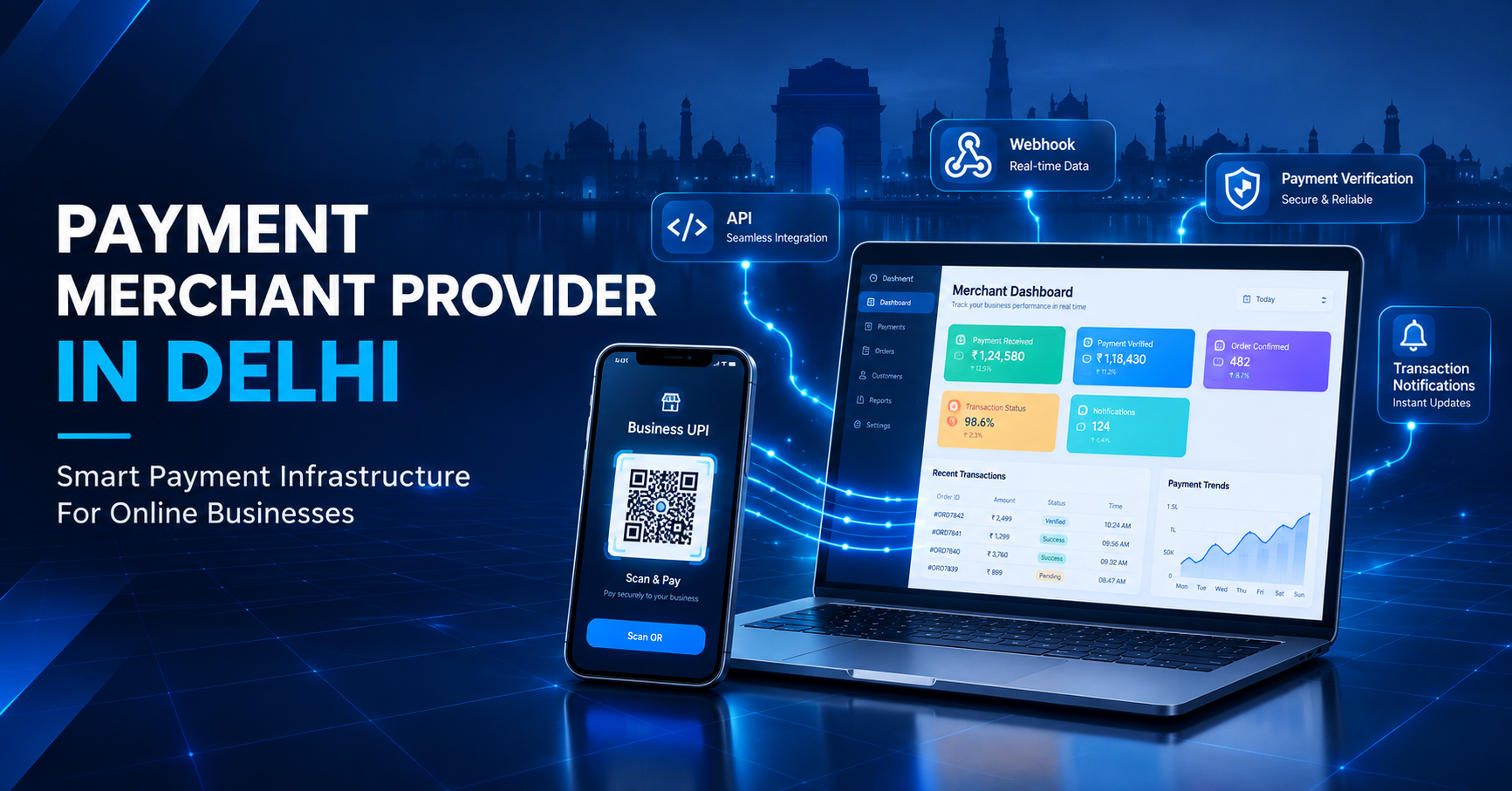
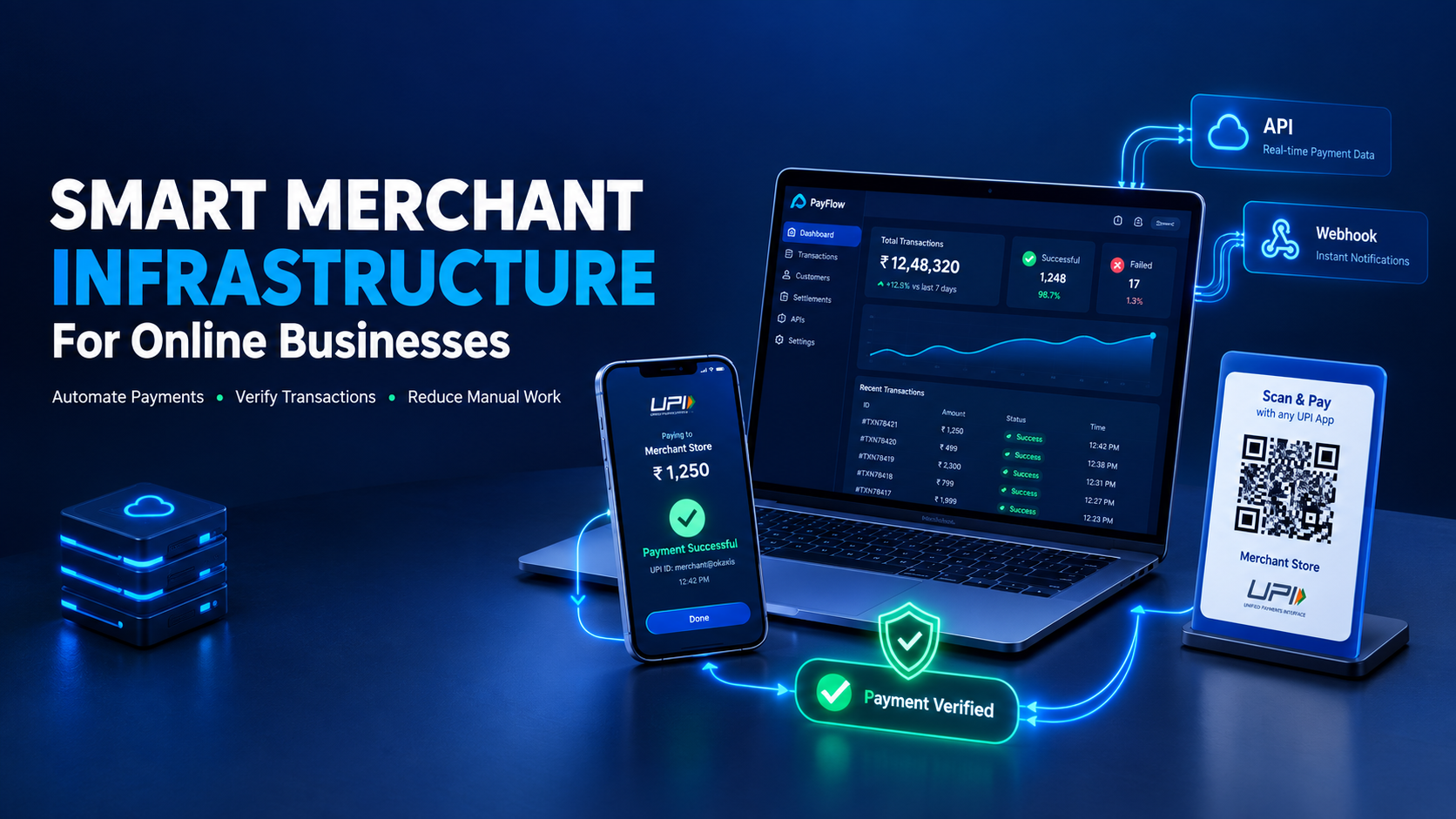
JaduPe is positioned as Smart Merchant Infrastructure for Online Businesses. Its core proposition is straightforward: businesses can connect a supported existing Merchant UPI ID or QR Code with smart payment automation technology and use that infrastructure across their website or mobile application. The platform highlights automatic payment verification, UPI Intent, QR payments, APIs, webhooks, and integration capabilities designed for online businesses.
The value proposition can be summarized in a simple workflow:
Your Merchant UPI → JaduPe Payment Automation → Website/App → Payment Verification → Business Workflow
That means the business does not have to treat payment confirmation as a completely separate manual activity. Instead, payment-related events can become part of the digital workflow. For a growing online business, that can mean less repetitive checking, faster status updates, better customer communication, and a more organized payment operation.
JaduPe also states that payments are collected directly in the merchant's own account and that the platform does not hold or process customer funds. That distinction is important for businesses evaluating different payment technology models.
A Practical Example of Automated UPI Payment
Consider an online store selling electronics accessories. A customer adds a ₹2,499 product to the cart and reaches checkout. Instead of paying and then waiting for an employee to check a screenshot, the customer uses the available UPI payment experience connected to the merchant's supported setup.
The customer completes the payment. The payment-status workflow then processes the relevant information and communicates the applicable result to the connected website. If the payment is successfully verified, the order can move from Payment Pending to Payment Successful, allowing the business's existing order workflow to continue. If there is an unusual or unresolved situation, the transaction can be handled according to the business's exception process.
The difference may appear small to the customer, but it can be significant operationally. Multiply that one order by hundreds of transactions and the value of automation becomes much easier to understand. Instead of asking employees to repeatedly answer "Has this customer paid?", the technology can handle the normal workflow while people focus on exceptions, customer service, and business operations.
Key Benefits of Moving to Smart Payment Automation
The most obvious benefit is reduced manual work, but the advantages extend beyond saving employee time. A connected payment workflow can help businesses create faster order confirmation, reduce unnecessary customer queries, improve operational consistency, and make payment-related processes easier to scale. It can also give developers a cleaner architecture for connecting payment events with business logic.
The major benefits include:
- Reduced manual payment checking
- Less dependence on payment screenshots
- Faster payment-status updates
- Better customer checkout experience
- Website and mobile app integration
- Developer-friendly API connectivity
- Webhook-based payment notifications where supported
- Better handling of growing transaction volumes
- More organized payment workflows
- Lower repetitive operational workload
JaduPe's own infrastructure focuses on these same areas, including automated verification, existing Merchant UPI integration, UPI Intent and QR payments, APIs, webhooks, and website/mobile application connectivity.
How to Decide Whether Your Business Needs Automation
The easiest way to evaluate your current payment process is to look at where human effort is being spent. Ask yourself: Does someone check screenshots after customers pay? Are orders waiting for manual payment confirmation? Do customers frequently ask whether their payment has been received? Does your support team spend time matching payments with orders? Are developers maintaining workarounds because your payment status is disconnected from your website or application?
If the answer to several of these questions is yes, your business may have reached the point where payment automation deserves serious consideration. You do not necessarily need to replace every component of your existing payment setup. In many cases, the smarter question is how technology can connect the payment infrastructure you already use with the software that runs your business.
Before implementation, businesses should evaluate supported merchant accounts, integration requirements, API capabilities, security controls, transaction-status handling, reporting, pricing, support, and their own regulatory/compliance obligations. A payment automation solution should fit the business rather than forcing the business to redesign everything around the technology.
The Future of Merchant Payment Infrastructure
The future of online payments is not simply about making it easier for a customer to press "Pay." The bigger opportunity is creating a connected transaction lifecycle in which payment collection, verification, order processing, notifications, reconciliation, and customer communication work together. As UPI transaction volumes continue to operate at enormous scale, businesses have stronger reasons to improve the infrastructure surrounding their payments. NPCI's August 2026 data alone shows how large the UPI ecosystem has become, with more than 24.5 billion transactions processed that month.
That is why smart merchant infrastructure is becoming an important concept for online businesses. Companies do not simply need another payment button; they need payment technology that fits into their existing websites, apps, databases, and operational workflows. The shift from manual payment checking to automation is therefore less about following a technology trend and more about removing friction from a process that has become central to modern digital commerce.
Conclusion
Manual payment verification may work when an online business is small, but growth changes the equation. More customers mean more transactions, more transactions mean more payment confirmations, and more confirmations can mean more repetitive work for the operations team. What starts as a simple process of checking a payment screenshot can eventually become a serious bottleneck affecting order fulfillment, customer support, employee productivity, and the overall customer experience.
Smart payment automation offers a more scalable approach. By connecting a supported Merchant UPI ID or QR Code with suitable payment automation technology, businesses can reduce repetitive verification work and connect payment status with their websites or applications. APIs, webhooks, UPI Intent, QR-based payment experiences, and automated status workflows can help turn a disconnected payment process into a more organized digital workflow. JaduPe is built around this concept, helping businesses use their existing merchant payment setup with smart infrastructure designed for payment automation.
The bigger lesson is simple: a successful online payment should not create more manual work for the business. When payment collection and payment verification become part of one connected workflow, businesses can spend less time checking transactions and more time serving customers, improving products, and growing their operations.
FAQs
1. What is smart payment automation?
Smart payment automation uses technology to automate suitable parts of the payment workflow, such as payment verification, status updates, notifications, and communication between a merchant payment setup and a website or application. It helps reduce repetitive manual tasks while allowing businesses to maintain appropriate review processes for exceptions.
2. Why is manual UPI payment verification a problem for online businesses?
Manual verification can become time-consuming when transaction volume increases. Employees may need to check screenshots, transaction information, merchant applications, and order details repeatedly. This can delay order confirmation and increase the possibility of human errors.
3. Can businesses use their existing Merchant UPI ID or QR Code with JaduPe?
JaduPe is designed to help businesses connect their supported existing Merchant UPI ID or QR Code with its payment automation technology. The specific compatibility and implementation should be confirmed based on the merchant's payment setup.
4. Can payment automation work with websites and mobile apps?
Yes. Payment automation can be integrated with websites, mobile applications, SaaS platforms, and other online systems using suitable APIs and event/webhook workflows. JaduPe provides developer-oriented integration capabilities for connecting payment workflows with websites and applications.
5. Does payment automation eliminate the need for human verification completely?
Not necessarily. The goal is to automate normal, repeatable payment workflows and reduce unnecessary manual checking. Businesses should still maintain appropriate controls for failed, unusual, disputed, or otherwise exceptional transactions and follow applicable security and compliance requirements.