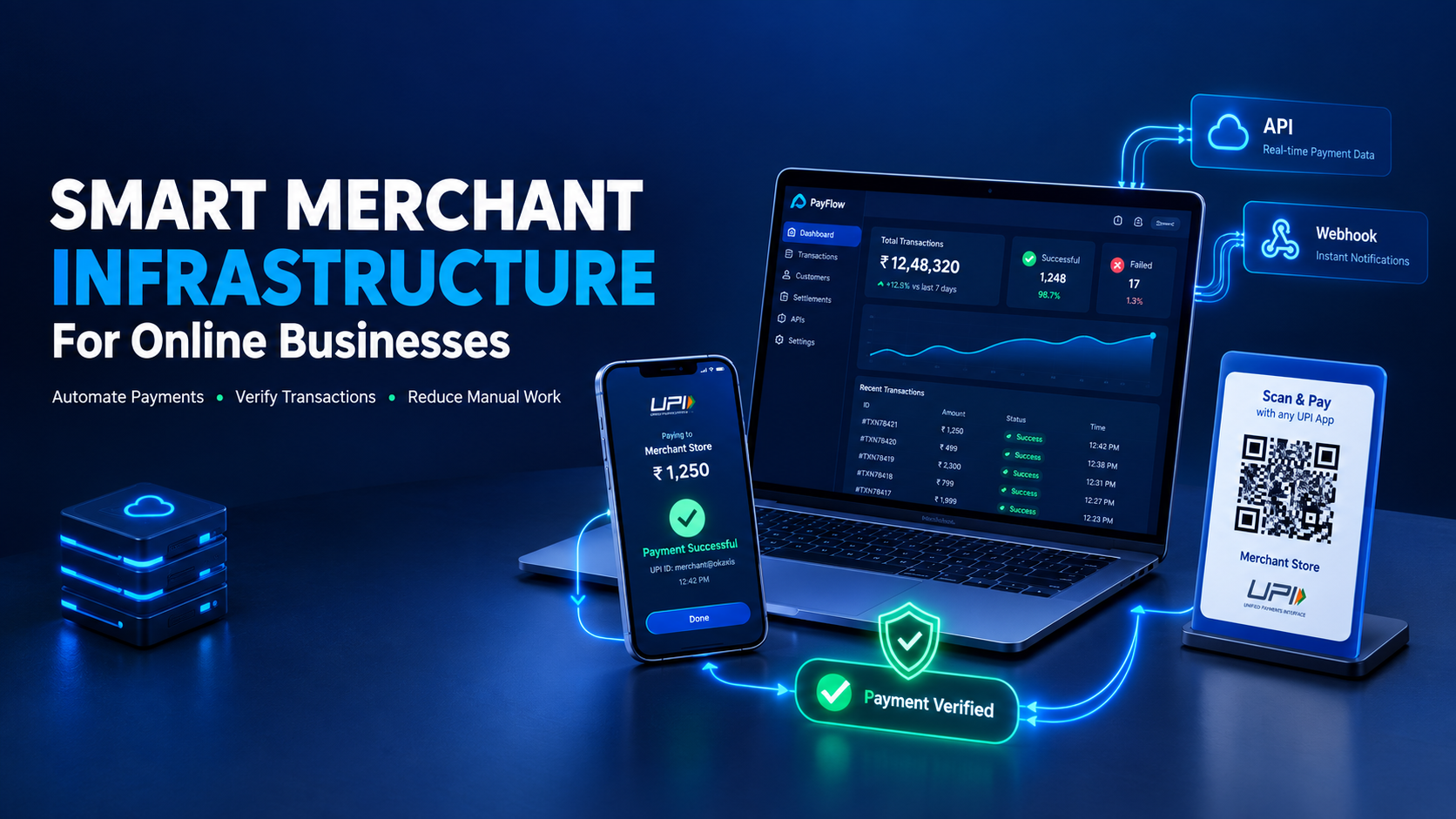
Smart Merchant Infrastructure for Online Businesses
Online payments have completely changed the way businesses collect money from customers.
Today, a customer can place an order, make a UPI payment from a smartphone, and expect the business to confirm that payment almost immediately.
But for many online businesses, the difficult part is not simply collecting the payment.
The bigger challenge is knowing whether the payment has been successfully received and updating the website or application accordingly.
When payments are checked manually, businesses may need to review transaction details, payment screenshots or merchant applications again and again.
As transaction volume grows, this can become time-consuming.
This is where Smart Merchant Infrastructure can help.
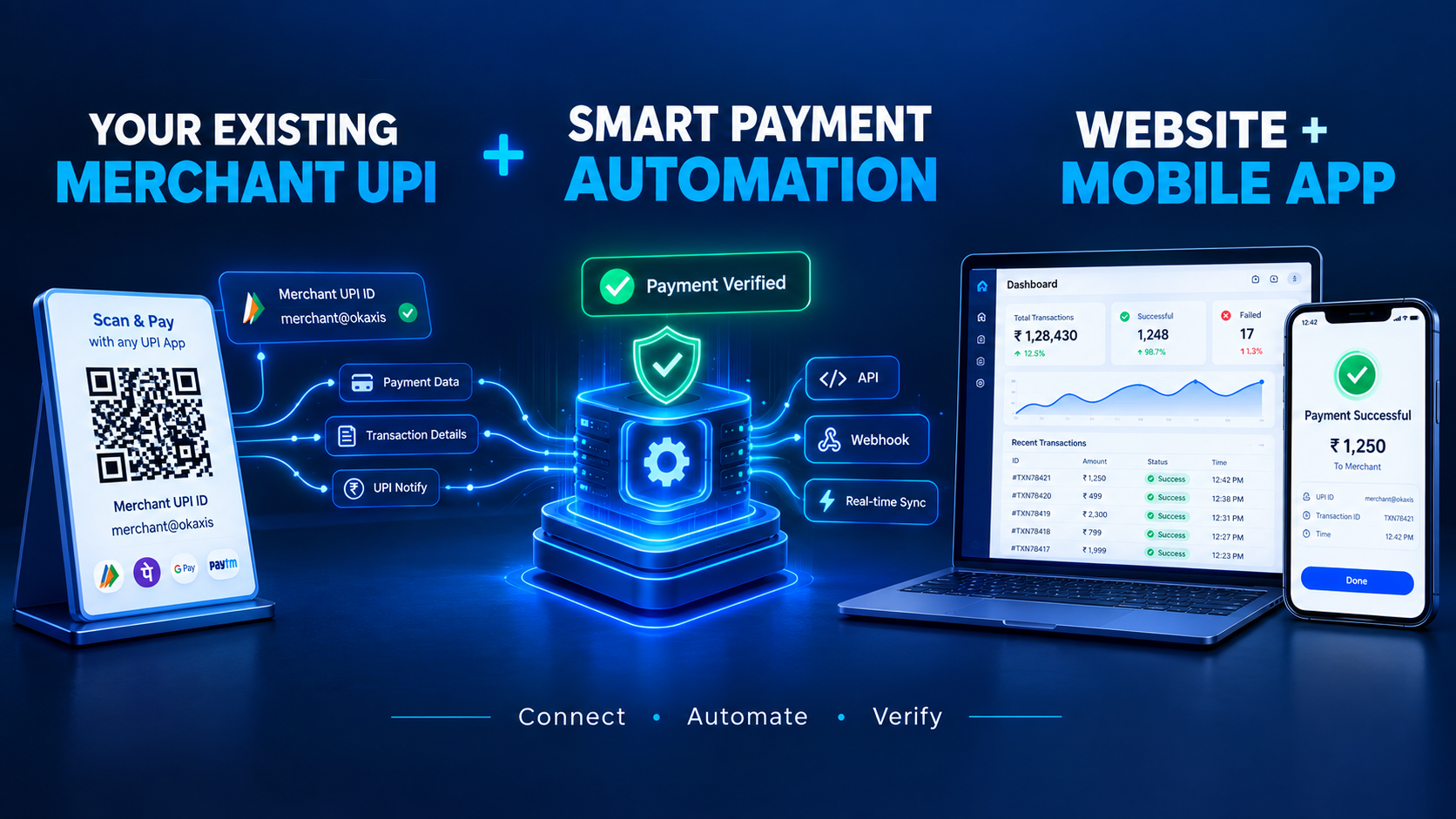
JaduPe helps businesses connect their existing Merchant UPI ID or QR Code with smart payment automation technology.
The goal is simple:
Automate Payment Verification. Reduce Manual Work. Deliver a Faster Payment Experience.
What Is Smart Merchant Infrastructure?
Smart Merchant Infrastructure is a technology layer that helps businesses connect their existing merchant payment setup with their website, application or online platform.
Instead of completely changing the way a business currently receives payments, the focus is on making the existing merchant setup smarter through technology.
For a supported Merchant UPI setup, the workflow can connect:
Merchant UPI ID / QR Code
↓
Payment Automation Technology
↓
Website or Mobile App
↓
Payment Verification
↓
Payment Status Update
This type of infrastructure can be particularly useful for businesses that already use Merchant UPI and want to reduce repetitive manual payment checking.
Why Online Businesses Need Payment Automation
Imagine an online business receiving 20 or 30 payments every day.
A team member can manually check those payments.
Now imagine the same business starts receiving hundreds of payments every day.
Manual verification becomes much harder.
The business may have to:
- Check payment notifications
- Match transaction details
- Check payment screenshots
- Confirm successful payments
- Update customer orders
- Respond to customers asking about payment status
This repeated work takes time.
With payment automation, businesses can connect their payment workflow with their website or application so that successful payment information can be handled digitally.
The purpose is not just to make payments faster.
It is to make the entire payment workflow more organized and automated.
Connect Your Existing Merchant UPI ID
One of the important ideas behind JaduPe is that businesses can work with their existing Merchant UPI setup.
A business may already have:
- Merchant UPI ID
- Business QR Code
- Merchant UPI account
- Existing payment setup
Changing the entire setup may not always be convenient.
JaduPe is designed to help businesses connect their existing Merchant UPI ID or QR Code with smart payment automation technology.
This means businesses can focus on making their existing payment workflow smarter rather than unnecessarily changing their current merchant setup.
How Merchant UPI Payment Automation Works
Let's understand this with a simple example.
Suppose you have an online store.
A customer purchases a product worth ₹1,000.
Step 1: Customer Places an Order
The customer visits your website or mobile application and selects a product.
Step 2: Customer Goes to Payment
The customer chooses the available UPI payment option.
Step 3: Customer Completes the Payment
The customer makes the payment using their preferred UPI application.
Step 4: Payment Is Verified
The payment automation system checks the relevant payment information.
Step 5: Payment Status Is Updated
Once the payment is successfully verified, the website or application can receive the relevant status.
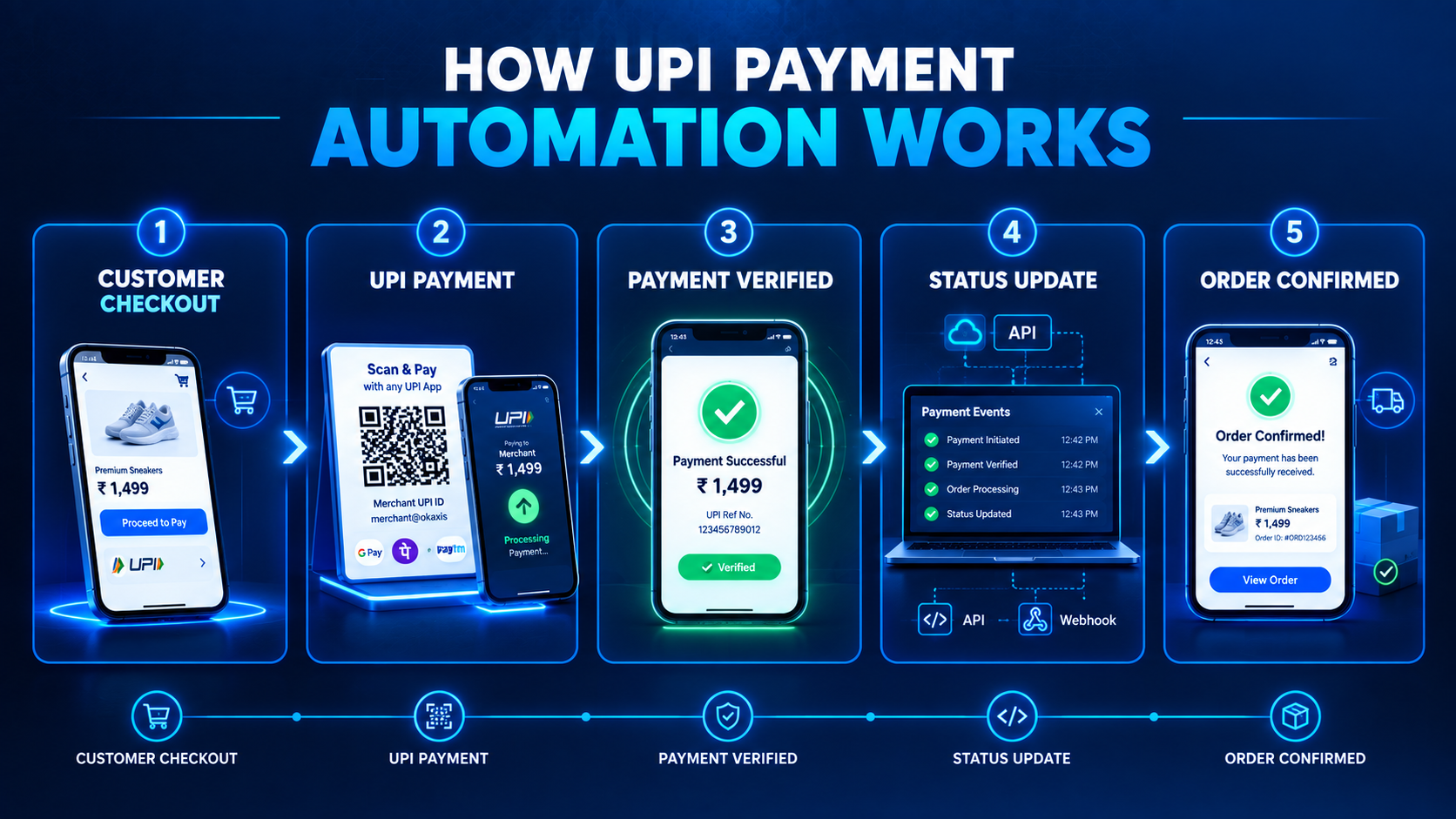
Step 6: Order Processing Continues
The business can then continue with order confirmation or the next required workflow.
This can significantly reduce the need for repetitive manual checking.
Manual Payment Verification vs Automated Payment Verification
The difference becomes easier to understand with a simple comparison.
| Manual Payment Verification | Automated Payment Verification |
|---|---|
| Payment is checked manually | Payment status is handled digitally |
| Screenshots may need checking | Less dependence on screenshots |
| More repetitive work | Reduced manual workload |
| Difficult to manage at scale | Better suited for growing transaction volumes |
| Customer may need to wait | Faster status updates |
| More operational effort | More streamlined workflow |
Automation does not mean that every business process becomes completely hands-free.
Instead, it helps reduce repetitive tasks and allows businesses to create a more connected payment workflow.
Payment Verification for Websites
For an online business, payment verification is an important part of the checkout experience.
A customer doesn't just want to make a payment.
They want to know:
“Did my payment go through?”
And the business needs to know:
“Was the payment successfully received?”
A connected payment verification system can help both sides.
For example:
Customer Payment
↓
Payment Verification
↓
Payment Status
↓
Website Updates Order
↓
Customer Gets Confirmation
This creates a smoother experience compared with manually checking every transaction.
Payment Automation for Mobile Applications
Smart payment infrastructure isn't limited to websites.
It can also be connected with mobile applications.
Consider an application where customers purchase products or services.
The basic workflow can be:
Select Product
↓
Checkout
↓
UPI Payment
↓
Payment Verification
↓
Application Receives Status
↓
Order / Service Confirmation
With API-based integration, developers can connect payment-related workflows with the application's backend.
This can be useful for businesses building Android applications, web applications, SaaS platforms and other online products.
Merchant QR Code and Payment Automation
QR codes have become a common way for businesses to accept UPI payments.
But simply displaying a QR code is only one part of the payment process.
For an online business, the bigger requirement may be:
How do I know when the customer has actually completed the payment?
This is where payment automation becomes useful.
A merchant QR-based payment workflow can be connected with technology that helps the business manage payment status and verification.
Instead of:
QR → Customer Pays → Customer Sends Screenshot → Business Checks → Order Confirmed
The objective can be a more automated flow:
QR → Customer Pays → Payment Verified → Status Updated → Order Processed
That can help reduce unnecessary manual communication between the customer and business.
Payment Status APIs for Developers
For businesses with their own website or application, developers often need a way to communicate payment information between different systems.
This is where APIs become important.
A payment API can help connect the payment infrastructure with the business's backend.
For example:
Customer Payment
↓
Payment Infrastructure
↓
Payment Status
↓
API
↓
Business Backend
↓
Order Status Updated
This type of integration can help developers build a more automated payment workflow instead of relying on manual confirmation.
Webhooks for Payment Notifications
Webhooks can also play an important role in payment automation.
Instead of continuously checking whether a payment status has changed, a connected system can receive an event when a relevant payment update occurs.
For example:
Payment Successful
↓
Payment Event
↓
Webhook Notification
↓
Website Backend
↓
Order Updated
This can help create faster communication between payment activity and the business application.
For developers building online businesses, APIs and webhooks can make payment workflows easier to integrate into existing systems.
Benefits of Smart Merchant Infrastructure
1. Reduce Manual Payment Checking
Businesses can reduce repetitive payment verification work.
2. Use Your Existing Merchant Setup
Businesses can connect a supported existing Merchant UPI ID or QR Code rather than rebuilding their complete payment setup.
3. Faster Payment Experience
Automated payment-status handling can help create a smoother customer experience.
4. Website Integration
Payment automation can be connected with websites and online platforms.
5. Mobile App Integration
Businesses can also integrate payment workflows with mobile applications.
6. Developer-Friendly APIs
APIs can help developers connect payment functionality with their existing backend.
7. Payment Status Notifications
Payment-related events can be communicated to connected systems through suitable notification and webhook workflows.
8. Scalable Payment Workflow
Automation can become increasingly useful as transaction volumes grow.
Who Can Use Merchant UPI Payment Automation?
Smart payment infrastructure can be relevant for different types of online businesses.
E-Commerce Businesses
Automate payment verification for online orders.
SaaS Businesses
Connect payment workflows with software platforms.
Mobile Applications
Integrate payment verification into an application's backend.
Service Businesses
Confirm online payments for digital or offline services.
Online Stores
Create a more connected checkout and payment-status workflow.
Food & Delivery Platforms
Connect payment status with order processing.
Digital Platforms
Use APIs and automation to manage payment-related workflows.
The exact integration depends on the business model, merchant setup and technical requirements.
Why Businesses Should Reduce Manual Payment Verification
Manual work may seem manageable when transaction volume is low.
But as a business grows, small repetitive tasks can consume a significant amount of time.
For example:
100 payments
means potentially 100 payment checks.
If every transaction requires manual confirmation, the workload continues to increase with transaction volume.
Automation can help businesses move from:
Manual Checking
to
Technology-Assisted Verification
This allows teams to spend less time on repetitive payment tasks and more time on customer service, operations and business growth.
Smart Payment Automation for Growing Businesses
A small business may start with a simple Merchant UPI ID or QR Code.
As the business grows, its payment requirements also grow.
More customers.
More orders.
More transactions.
More payment confirmations.
More support queries.
This is where payment automation becomes increasingly valuable.
Instead of rebuilding the entire payment process from scratch, businesses can look at how their existing Merchant UPI setup can be connected with suitable technology.
JaduPe is designed around this concept.
JaduPe – Smart Merchant Infrastructure for Online Businesses
JaduPe helps businesses connect their existing Merchant UPI ID or QR Code with smart payment automation technology.
The platform focuses on helping businesses:
- Automate payment verification
- Reduce manual payment checking
- Connect Merchant UPI with websites
- Connect payment workflows with mobile apps
- Generate dynamic payment experiences
- Receive payment-status notifications
- Use APIs and webhooks
- Build a smoother payment workflow
The core idea is simple:
Your existing Merchant UPI setup can become smarter with payment automation technology.
JaduPe is focused on technology infrastructure for online businesses rather than positioning itself as a conventional bank or financial institution.
Businesses continue to use their own merchant accounts and are responsible for their applicable compliance requirements.
Final Thoughts
Online payment collection is no longer only about receiving money.
For modern businesses, the complete workflow matters:
Payment Collection → Payment Verification → Status Update → Order Processing → Customer Confirmation
When these steps depend heavily on manual work, managing a growing number of transactions can become difficult.
Smart Merchant Infrastructure can help businesses connect their existing Merchant UPI setup with technology that automates important parts of the payment workflow.
With JaduPe, businesses can connect their existing Merchant UPI ID or QR Code with smart payment automation technology and work toward a faster, more organized payment experience across their website or mobile application.
Smart Merchant Infrastructure for Online Businesses
Connect your existing Merchant UPI. Automate payment verification. Reduce manual work.
Frequently Asked Questions
What is Smart Merchant Infrastructure?
Smart Merchant Infrastructure is a technology layer that helps businesses connect their existing merchant payment setup with websites, applications and automated payment workflows.
Can I use my existing Merchant UPI ID with JaduPe?
JaduPe is designed to help businesses connect their existing supported Merchant UPI ID or QR Code with its payment automation technology.
Can payment verification be automated?
Yes, payment automation technology can help businesses automate relevant payment verification workflows and reduce repetitive manual checking.
Can JaduPe work with a website?
Yes. JaduPe provides technology and integration capabilities designed for websites and online platforms.
Can JaduPe be integrated with a mobile application?
Yes. Payment automation workflows can be integrated into mobile applications through suitable API-based integration.
What are payment webhooks?
Webhooks allow connected applications to receive notifications or events when a relevant payment-related status changes.
Why should businesses automate payment verification?
Automation can reduce repetitive manual work, improve payment-status handling and help create a smoother experience for customers.


